Jack–Dr. Mackey
Young Captain Jack · The Son of a SoldierJack–Dr. Mackey is the novel’s central counterfeit parent–child relationship: Dr. Mackey claims Jack as his son, but Jack refuses to recognize him, and the claim collapses when Colonel Stanton’s testimony and the recovered shipwreck papers establish Jack’s true parentage. The relationship turns the question of family into a struggle over evidence, authority, inheritance, and the right to define one’s own identity.
Origins in Adoption and Uncertainty
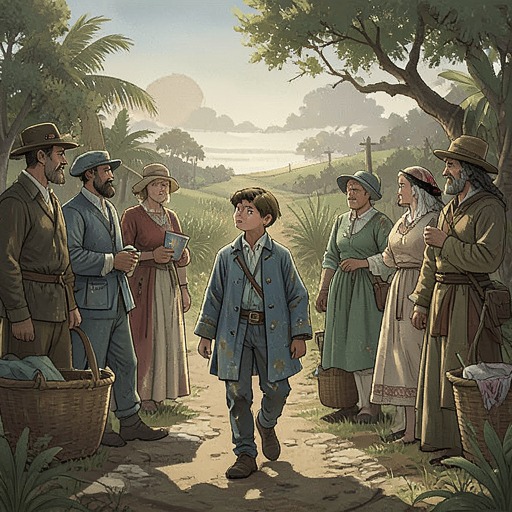
Jack’s first known family identity is not biological but adoptive. When he was three or four years old, he was rescued after a shipwreck and brought with his dying mother to the Ruthven plantation. Because the woman carried no identifying papers and her clothing was unmarked, the Ruthvens could not determine her name or the child’s parentage. Mrs. Ruthven preserved the woman’s clothing, an unmarked lace handkerchief, and a ring whose worn inscription could no longer be read, but these objects initially offered only fragments of a family history.
Within the Ruthven household, Jack nevertheless became Marion Ruthven’s brother in every meaningful domestic sense. The family had adopted him about ten years before the later conflict, and Marion explicitly told him that he was John Ruthven, her own brother. That assurance gives the later dispute its emotional force: Dr. Mackey does not simply offer Jack a new genealogy; he challenges the family structure that has raised and protected him. Earlier, Darcy Gilbert had repeated the cruel suggestion that Jack was a nobody who did not belong to the Ruthven family and would someday have to leave. Jack’s anxiety about being nameless therefore precedes Dr. Mackey’s arrival and makes the medical man’s assertion especially dangerous.
Dr. Mackey’s Claim
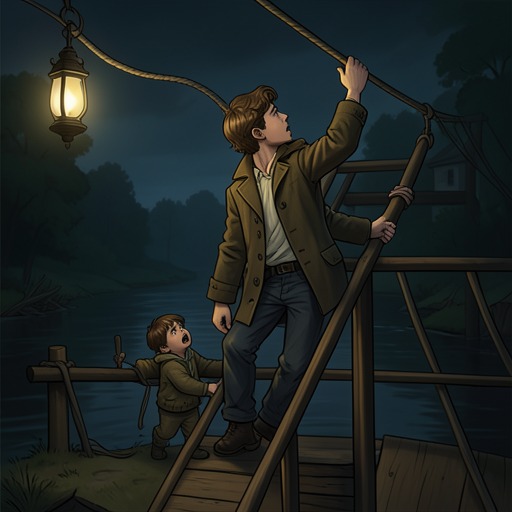
Dr. Mackey introduces the false relationship directly and dramatically. After an earlier encounter on the bridge, he meets Jack again and declares, “Jack, I am your father!” When Jack recoils in astonishment, Dr. Mackey repeats that he is Jack’s parent and insists that the claim is true. The assertion is unsupported at first, but its confident form attempts to convert speech into authority: the doctor presents himself not as a claimant seeking proof but as a father whose status should be accepted immediately.
The claim is also connected to a larger scheme. Dr. Mackey tells Jack that a large fortune is coming to both of them and offers Jack his full share on the condition that he publicly acknowledge Dr. Mackey as his father. Dr. Mackey further proposes to resign his commission as a surgeon in the Confederate army and take the necessary steps to claim the fortune. This bargain exposes the relationship’s material basis. His supposed fatherhood is not expressed through care, memory, or protection; it is made conditional on Jack’s public agreement and tied to access to property.
Others recognize the financial motive. A wounded soldier suggests that property may be coming to Jack and that Dr. Mackey wants to seize it. Marion and Jack consequently decide that Dr. Mackey’s record must be investigated. Jack states that he is now certain the doctor is not his father and recalls that he disliked Dr. Mackey from their first meeting at the bridge. Suspicion thus develops through both circumstantial motive and personal conduct rather than through Jack’s simple refusal to accept an unpleasant truth.
Resistance and Coercive Fatherhood
Jack rejects Dr. Mackey’s authority in explicit terms. When Dr. Mackey asks whether he intends to go with him, Jack answers that he does not. Dr. Mackey accuses him of being hard on his father, but Jack replies that he does not acknowledge him as his father. Dr. Mackey responds that he will soon be able to prove his claim, while Jack counters that he may then be able to prove Dr. Mackey an impostor. The exchange reverses the expected parent–child hierarchy: the alleged father demands obedience, but the alleged son demands legal and factual proof.
Dr. Mackey’s reaction reveals how little the relationship resembles genuine parenthood. When Jack says that Dr. Mackey was a bachelor and had never been married to Jack’s mother or to any other woman, the doctor falls back as if struck and angrily demands to know who supplied the information. His response is not a father’s attempt to reassure a confused child; it is the defensive anger of a claimant whose story has been challenged. The charge that he was never married directly attacks the foundation of his alleged biological connection to Jack.
The conflict becomes physically coercive when Dr. Mackey confines Jack and later returns to release him. He explains the treatment by saying, “Because I want you to come to your senses and understand that I am your father.” He brings Jack food and drink, but presents them as part of enforced obedience: a son who will not obey, he says, must be made to obey. The scene makes the false fatherhood literal as well as verbal. Dr. Mackey tries to manufacture filial submission through captivity, converting the language of parental discipline into a tool of imprisonment.
Evidence Against the Imposture
The story repeatedly contrasts Dr. Mackey’s assertion with material traces and independent testimony. Mrs. Ruthven’s ring and handkerchief preserve the only objects recovered from Jack’s mother, while Jack’s own dim memory contains a storm, enormous waves, and his mother holding him on the beach. These clues do not initially identify his father, but they establish a history that Dr. Mackey must explain rather than simply overwrite.
The recovered black tin box provides stronger evidence. Jack discovers it hidden in a tiny, filthy closet inside the wreck, under accumulated dirt and water damage, and opens its padlock with a key from his pocket. The box had been taken from the wreck of the Nautilus and later recovered from the outlaws’ camp after the guerrillas holding Jack were defeated. Its contents are ultimately delivered to Colonel Stanton as his precious papers. The physical journey of the box—from wreck, to hidden closet, to outlaw camp, and finally to Colonel Stanton—turns a threatened family story into a documentary chain.
Colonel Stanton’s own history also undermines Dr. Mackey. After being shipwrecked, Stanton was rescued only after more than twenty-four hours and later spent two months in a strange hospital before being transferred to an insane asylum. He remembers these experiences only dimly because the exposure affected both his body and mind. At the asylum, he says, a physician treated him brutally and tried to pry into his family affairs. When Stanton learns that Dr. Mackey claims Jack as his son, he identifies him as the villain responsible for his long confinement and calls him an impostor. His testimony supplies both a personal motive for Dr. Mackey’s deception and a direct accusation grounded in their earlier history.
Collapse of the False Relationship
The imposture is finally stated openly within the Ruthven household. When Marion asks whether Jack knows the truth, she tells him that Dr. Mackey is an impostor and explains that Colonel Stanton is present and knows the doctor too well. She then gives the decisive correction: Jack is not Dr. Mackey’s son but the colonel’s son. Jack reacts with disbelief and astonishment, but Marion says that Colonel Stanton has proved it beyond doubt.
This revelation changes the meaning of every earlier version of Jack’s identity. He is not the “nobody” described by Darcy Gilbert, nor Dr. Mackey’s son, even though he remains the adopted brother of Marion Ruthven and the child raised by the Ruthven family. His identity becomes layered rather than simply replaced: adoption explains his belonging, the shipwreck explains the obscurity of his origins, Colonel Stanton explains his biological parentage, and Dr. Mackey’s claim is exposed as a fraudulent attempt to occupy the place of father.
The relationship’s final defeat is accompanied by the recovery of the fortune’s documentary basis. After the battle in the mountains kills several guerrillas, including the men who had held Jack prisoner, the outlaws’ camp is searched. Along with stolen goods, investigators find the tin box from the Nautilus wreck. When Colonel Stanton examines the papers, he tells Jack that nothing now stands between them and their fortune. Dr. Mackey’s proposed fatherhood therefore fails on both moral and practical grounds: Jack does not yield to his demand, and the evidence that Dr. Mackey sought to control is restored to the true father and son.
Narrative Significance
Jack–Dr. Mackey dramatizes the difference between naming a relationship and earning one. Dr. Mackey possesses the language of fatherhood but not its protective obligations. He uses the title “father” to demand obedience, justify confinement, and secure property. By contrast, the Ruthvens’ adoption gives Jack a household before it gives him a genealogy, while Colonel Stanton’s eventual recognition is validated through memory, corroborating history, and recovered papers rather than through assertion alone.
The relationship also organizes the novel’s larger identity mystery. Jack’s self-understanding is repeatedly revised—from adopted Ruthven, to shipwrecked child of unknown origin, to alleged son of Dr. Mackey, and finally to Colonel Stanton’s son. Each version is tested against objects, testimony, remembered fragments, and conduct. Dr. Mackey’s false claim is therefore not merely a personal lie; it is an attempt to control the narrative by which Jack understands himself and the property to which that narrative may give him access. Its collapse restores both biological truth and Jack’s power to reject an imposed identity.